How Hirenix teaches
One chapter. 90 minutes.
Interview-ready.
Every concept starts with a real-world problem — the kind that actually shows up in production code. Nothing to cram; it just clicks. Every question comes with a model answer: exactly what to say in the room, and why. Then an AI mock interview on the same chapter.
- 📖Concept in 5 minutesNo jargon — straight to the point
- 🛠️Real-world problemThe kind production code throws at you
- 💬Model answerExactly what to say in the room
- 🧠FlashcardsRevise in 10 minutes
- 🤖AI mock interviewIt asks follow-ups too
- 📊Weak topicsSee exactly where you're stuck

The difference isn’t the content — it’s the filter. Only what’s actually used in production and actually asked in interviews. Textbook topics the industry never touches don’t make the cut.
Certificates
Learn all 23 topics and earn your HR Interview certificate
Finish every HR Interview topic and a certificate with your name on it is issued instantly. No exam, no waiting. Download it, share it on LinkedIn, and put it on your resume.
Chapter certificate
Your name, the HR Interview course and all 23 topics on it.
Anyone can verify it
Each certificate has a QR code and a public link at hirenix.in/verify.
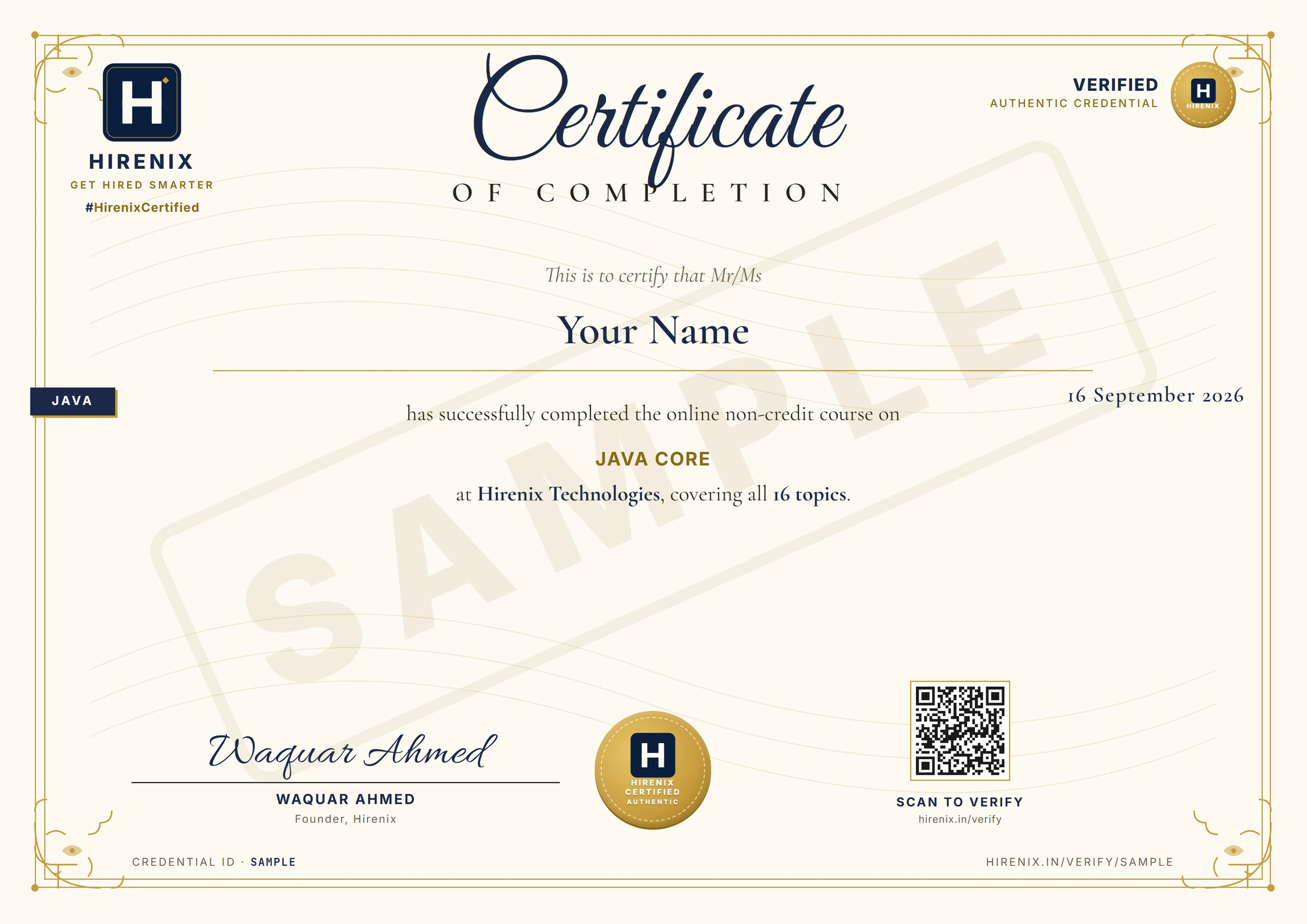
Verified credential
hirenix.in/verify/…
What you’ll learn
- ●What the HR round actually judges
- ●The STAR method and your story bank
- ●Tell me about yourself
- Walk me through your resume and projectsPro
- Strengths and weaknessesPro
- Pressure, deadlines and prioritisingPro
- Teamwork and leadershipPro
- Feedback, criticism and motivationPro
- Why do you want to join us?Pro
- Why should we hire you?Pro
- Five-year goals and commitmentPro
- Relocation, shifts and flexibilityPro
- Failure, mistakes and rejectionPro
- Conflict and difficult situationsPro
- Gaps, backlogs and low marksPro
- Why are you leaving your current job?Pro
- Trick and opinion questionsPro
- CTC vs in-hand salaryPro
- Expected salary and negotiationPro
- Notice period, bond and joining datePro
- Questions to ask HR, and the follow-upPro
- RecapPro
- Practice: A Full HR Round, Fresher and Job SwitchPro
Free lessons
What the HR round actually judges
Most candidates prepare for the technical round and treat the HR round as a formality. The real interview reports behind this course say otherwise - and they also show that the HR round is usually short, which makes every answer count more, not less.
Here is what 16 real interview reports on GeeksforGeeks (2021-2026) describe:
| What the report says | Company / round |
|---|---|
| The whole HR round was two questions: "Are you ready to relocate?" and "Are you ready for night shift?" | TCS Ninja |
| HR asked about relocation and night shifts, then did document verification | TCS Digital (2026 graduate) |
| The whole interview lasted about seven minutes: introduce yourself, explain your project | Accenture ASE/AASE |
| Technical and HR were one combined round; HR asked about relocation and night shifts | Cognizant GenC |
| After the questions, HR asked to see the college ID and Aadhaar card, and asked "Are you comfortable with the bond?" | Capgemini |
| For a 3-5 year experienced hire, the HR round was "just a CTC discussion" | Infosys |
| The HR discussion was a short phone call: why leave the current job, and the CTC on offer | Paytm (2-3 years) |
So the HR round has no single fixed format. It can be two yes/no questions, a combined technical + HR interview, a document check, or a phone call about money. Every one of those formats is still a filter.
What HR is really testing
Across all these formats, HR is screening for six things. Keep them in mind - every later topic in this course maps back to one of them.
- Communication. Can you answer clearly and briefly in simple English? Not an accent test - a "will clients and managers understand you" test.
- Consistency and honesty. Does what you say match your resume, your technical round and your documents? A mismatch - in dates, marks, a project claim - is the fastest way to fail an otherwise good interview.
- Stability. Will you stay? Hiring and training a fresher costs the company time and money, so HR listens for signals that you will leave early: "I'm preparing for higher studies", "I just want some experience first", unexplained job changes. This is why questions like "Where do you see yourself in five years?" exist.
- Flexibility. Will you accept the job as it actually is - the location, the shifts, the project you are placed on, a service agreement if there is one? The TCS and Cognizant reports above show these are asked even when nothing else is.
- Attitude and fit. How do you talk about teammates, failures, past employers? Do you blame, or take ownership?
- Logistics. Documents, joining date, notice period, salary expectations. Boring, but a wrong answer here can end the process after you have cleared everything else.
The trap: "HR round is just a formality"
The trap is believing that because the technical round was hard, the HR round is a courtesy. These are the ways candidates fail it:
- Casual answers to "simple" questions. "Relocate? Hmm, I'd prefer my home city only." To you it is a preference; to HR it is a candidate who may refuse the posting.
- Contradicting yourself. Your resume says you led the project; in the HR round you say "my friend did most of it". HR notices, and now doubts everything else.
- Leaking a leaving plan. "I'll work for a year or two, then do an MBA." Honest - and exactly the stability signal HR is screening against. (How to answer the higher-studies question honestly is in topic 11.)
- Documents not ready. Original marksheets at home, a name spelled differently on two certificates, dates on the resume that don't match the offer letter - and no explanation ready.
- Online round problems. A dead microphone, a dark room, looking at your own video instead of the camera, reading from another window. On a ten-minute call, three minutes lost to setup is a third of your round.
- The opposite trap - over-scripting. Long memorised answers to short questions. HR asked yes or no; you gave a speech.
Answer framework: Direct → Reason → Proof
Most HR questions in a short round are closed or nearly closed: "Are you ready to relocate?", "Is this your original marksheet?", "When can you join?". Use a three-step shape:
- Direct answer first - yes, no, or the number/date - in the first few words.
- One reason - why, in one sentence.
- One proof or condition - a fact that backs it up, or an honest condition stated calmly.
Stop there. If HR wants more, they will ask. This shape passes the first three filters at once: it is clear (communication), it is checkable (consistency), and it does not hide anything (honesty).
Before any HR round, run this checklist:
| Before the round | Why |
|---|---|
| Re-read your own resume, line by line | Everything on it is fair game; your technical round answers must match it too |
| Keep originals + one photocopy set + scans on your phone: marksheets, degree/provisional certificate, ID proof; for job switchers, offer/relieving letters and recent payslips | Document verification can happen in the same round (TCS Digital, Capgemini reports) |
| Check every date and name spelling across resume and documents | Mismatches are what document verification is looking for |
| Decide your honest answers on relocation, shifts and service agreements before the call | These are asked even in two-question rounds |
| Online: test camera, microphone and internet; sit facing a light; keep the camera at eye level; close other windows | A setup failure eats the round |
Online rounds - eye contact. On video, eye contact means looking at the camera, not at the interviewer's face on your screen. You don't need to do it all the time; look at the camera when you start and finish a point. Keep a plain background and a phone hotspot ready as a backup.
Sample answer — fresher (template)
The situation: during document verification, HR notices that your name is spelled differently on two documents (or a date doesn't match). This is where the Direct → Reason → Proof shape matters most - a calm, factual answer ends the issue; a nervous or vague one creates doubt.
"Yes, I'm aware of that. My [10th marksheet] shows my name as [spelling A], while my [degree certificate / Aadhaar] shows [spelling B], because [honest reason - e.g. the school board recorded it that way]. I have [proof - e.g. a gazette notification / an affidavit / a correction request submitted on [date]], and I can share a copy by [date]."
If you have no proof yet, say so and say what you are doing about it: "I haven't got the correction yet; I have applied to [authority] and will send the document as soon as I receive it." Never invent a document you don't have.
Sample answer — experienced (template)
The situation: HR points out that your resume says you joined [Company] in one month, but the offer letter or relieving letter shows another.
"You're right - my resume says [Month Year], and my [offer / relieving] letter says [Month Year]. The difference is because [honest reason - e.g. I wrote the month I got the offer, but my joining date was [date]]. My [relieving letter / payslips from [first month]] show the exact joining date, and I'll correct the resume today so everything matches."
Companies can check your employment dates with your previous employer, so the only safe resume is one whose dates you can prove. Rounding "March" to "Feb" to hide a gap is exactly the kind of small mismatch that turns into a big doubt.
Follow-up grilling: what HR asks next
These follow-ups come after almost any short HR answer. Each one is testing one of the six filters.
| Follow-up | What HR is checking | How to handle it |
|---|---|---|
| "Are you sure? Think again." (after "Yes, I can relocate") | Whether your yes is real or a reflex | Repeat the yes calmly, with your one reason. If you have a genuine condition, state it now - not after the offer. |
| "Why didn't you fix this mismatch earlier?" | Carelessness vs honesty | Admit it plainly ("I should have"), then say what you have done since. No excuses about the office or the university. |
| "Anything else in your documents or background we should know?" | Whether you volunteer problems or hide them | If there is something (a gap, a backlog, a pending result), say it now, briefly, with the facts. Surprises found later are worse. |
| "Your technical interviewer said you [X]. Is that right?" | Consistency between rounds | Answer factually. If you said something wrong earlier, correct it: "I was wrong there - the correct answer is..." |
| "Do you have any other plans - higher studies, government exams?" | Stability | Answer honestly (topic 11 covers how). Do not deny a plan you actually have - it tends to surface later. |
| "Your internet keeps dropping - should we reschedule?" | How you handle a problem under pressure | Say what you will do ("I'm switching to my phone hotspot, one minute") or accept the reschedule politely. Do not keep apologising. |
When to use this answer shape: for closed and nearly-closed HR questions - relocation, shifts, documents, dates, joining, "are you comfortable with..." - and whenever HR points out a mismatch. Use the checklist before every HR round, including a phone call from a recruiter.
When NOT to use it: for open questions like "Tell me about yourself" (topic 3) or "Tell me about a time you failed" (topic 13) - those need a story, and three short sentences will sound evasive. And do not use "Direct" to mean blunt: a short answer can still be warm - "Yes, happy to" is direct; "Yes." with no reason can sound reluctant.
Stability is the filter candidates forget most, because it is never asked directly. Listen for it behind questions about plans, family, location and higher studies - and answer those with the truth, framed around why you want this job now.
The STAR method and your story bank
A large part of any HR round is questions that start with "Tell me about a time...", "Give me an example of..." or "Describe a situation where...". In the lists and reports behind this course, the most common of them are about failure and mistakes, working under pressure, teamwork, criticism and conflict - and Accenture interview write-ups on GeeksforGeeks describe team-lead situations too ("a member of your team can't finish their task - what do you do?").
These are called behavioural questions. They all ask for the same thing - a real story - so they can all be answered with the same tool. This topic teaches that tool (STAR), and the preparation that makes it work in a live interview: a story bank.
What HR is really testing
A behavioural question is based on one idea: how you behaved in a real situation is a better guide to how you will behave at work than what you say you would do. So HR is listening for:
- A real event. Specific people, a specific deadline, a specific problem. Vague stories sound invented, even when they are not.
- Your own actions. Not what "the team" or "we" did - what you decided and did.
- Judgment. Why you chose that action over others.
- A result. What changed because of what you did - even if the result was only partly good.
- Reflection. What you learned, or would do differently. This is what separates a mature answer from a lucky story.
The trap: answers that fail
- The hypothetical answer. Asked "Tell me about a time you handled pressure", the candidate says "I would stay calm, prioritise and communicate." That answers a different question. HR asked for a time; you gave a theory.
- The "we" story. "We divided the work, we stayed late, we submitted on time." HR still doesn't know what you did. Every "we" hides your part.
- All situation, no action. Two minutes describing the project and the problem, fifteen seconds on what you did. The action is the part being graded.
- No result, or no ending. The story stops at "...so I talked to him." And then?
- The hero story that blames others. "My teammates were lazy, so I did everything myself." It shows effort - and it also shows you blaming the team, which is an attitude signal HR notes.
- The borrowed or invented story. A classic from a prep website, or a friend's internship told as yours. It collapses at the second follow-up, because you don't know the details. And inventing experience is exactly what HR's consistency check is built to catch.
- Freezing. Trying to find a story while the interviewer waits. This is a preparation problem, not a nerves problem - and the story bank below fixes it.
Answer framework: STAR (Situation, Task, Action, Result)
STAR stands for Situation, Task, Action, Result:
| Step | What to say | How much |
|---|---|---|
| Situation | Where and when; just enough context to follow | 1-2 sentences |
| Task | What you were responsible for, or what had to happen | 1 sentence |
| Action | What you did, step by step, and why - in "I" | The biggest part |
| Result | What happened because of it; a number if you have an honest one; plus one line on what you learned | 1-2 sentences |
A useful way to remember the balance: keep Situation and Task short, and spend most of your time on Action. Many candidates do the opposite.
Adding the learning. End with one sentence of reflection ("Since then, I..."). For failure and mistake questions it is not optional - it is the answer.
The story bank
You cannot build a good STAR story in the ten seconds after a question. So build five or six before the interview, and reuse them. One good story usually fits several questions:
| Question family | Story you need |
|---|---|
| Pressure / tight deadline | A time you delivered despite a real time crunch |
| Teamwork / team lead | A time you worked with others, ideally where something went wrong in the team |
| Conflict / disagreement | A time you disagreed with someone and resolved it without blame |
| Failure / mistake | A real failure or mistake - one that is yours, with what you changed after |
| Criticism / feedback | A time you got critical feedback and acted on it |
| Achievement / initiative | Something you are proud of that you started or pushed yourself |
How to build it:
- List every place you have real experience: projects, internship, part-time work, college events, sports, family responsibilities, clubs.
- For each row of the table, pick one real event. One event can cover two rows (a project crisis can be both "pressure" and "teamwork").
- Write each story in STAR as bullet points - not as a paragraph to memorise. You want the facts in your head, not the sentences.
- Say each one out loud, in about one to two minutes.
- For each story, prepare the three follow-ups in the table below.
Freshers often think they have no stories. College gives plenty: a project partner who dropped out, a fest where the sponsor pulled out, an exam week clashing with a submission, a hostel or club responsibility. The size of the event matters less than how clearly you show your thinking.
Sample answer — fresher (template)
Question: "Tell me about a time you worked under pressure."
"In my [final year / third semester], our team of [number] had [one sentence situation - e.g. two weeks to submit our [project name] project], and [what went wrong - e.g. one member had to leave for a family emergency]. My task was [your responsibility - e.g. the backend, and now also his part - the report generation module]. I [action 1 - e.g. listed what was left and split it into daily targets], [action 2 - e.g. asked our guide which features were essential so we could drop the rest], and [action 3 - e.g. took the report module myself and stayed in touch with him so he could review it when he was back]. We [honest result - e.g. submitted on time with the core features working and scored [grade]]. What I learned is [reflection - e.g. to cut scope early instead of hoping to finish everything], and I've done that in every project since."
Every [bracket] is your real story. If your result was only partly good ("we submitted, but one feature didn't work"), say that - a real, partial result is more believable than a perfect one.
Sample answer — experienced (template)
Question: "Tell me about a time you had a conflict with a colleague."
"At [company type], I was working on [project/feature] with a [role - e.g. colleague from the testing team]. We disagreed about [issue - e.g. whether to release on [date] with [number] known minor bugs]. My task was [responsibility - e.g. to get the release ready without damaging the working relationship]. I [action 1 - e.g. asked for a short call instead of arguing on the ticket], [action 2 - e.g. went through each bug with her and agreed which were really blocking], and [action 3 - e.g. proposed releasing on [date] with a fix for the two blocking ones and a follow-up patch plan]. The result was [honest result - e.g. we released [number] days later than planned but without the issues she was worried about]. What I took from it is [reflection - e.g. to raise disagreements on a call early rather than in comments]."
Notice what is not there: no blame, no "she was wrong", no "I was right". HR is listening for how you work with people, not for who won.
Follow-up grilling: what HR asks next
Any STAR story invites these follow-ups. Prepare them for each story in your bank.
| Follow-up | What HR is checking | How to handle it |
|---|---|---|
| "What exactly did you do?" | Your part vs the team's | Name two or three actions that were yours, in "I". |
| "What would you do differently now?" | Reflection and maturity | Give one real change. "Nothing" sounds either untrue or unreflective. |
| "What did the other person say / how did they react?" | Whether the story is real and whether you understood the other side | Describe their view fairly, in one or two sentences. Real stories have this detail. |
| "Give me another example." | Whether you have more than one prepared story | Use the next story from your bank - this is why you build five or six. |
| "What if that hadn't worked?" | Whether you think in options | Name your next step honestly - who you would have asked, what you would have cut. |
| "How did you measure that result?" | Whether the number is real | Only use numbers you can explain. If you don't have one, describe the outcome in words. |
| "Tell me about a time it did not go well." | Whether you only have success stories | Use your failure story. Take ownership, then the learning. |
When to use this answer shape: whenever the question asks for an event - "Tell me about a time...", "Give me an example...", "Describe a situation...", "Have you ever...?" - and for "How do you handle X?" questions, where a short STAR example is stronger than a description of your habits.
When NOT to use it: for closed and logistics questions (relocation, shifts, salary, notice period - use Direct → Reason → Proof from topic 1); for "Tell me about yourself" (Present → Past → Future, topic 3); and when HR asks a pure hypothetical - "What would you do if...?" There, give your approach first in two or three sentences, and then, if you have one, add "Something similar happened when..." as a short example. Don't force a two-minute STAR story onto a question that didn't ask for one.
Tell me about yourself
"Tell me about yourself" is the first thing HR says in almost every Indian HR round. For this course we tallied 14 prep-site question lists and 16 real interview reports on GeeksforGeeks (TCS, Infosys, Wipro, Accenture, Cognizant, Capgemini, HCL, Paytm, 2021-2026). It appeared in 13 of the 14 lists and 5 of the 16 reports. Only one question matched that overall count: "Are you willing to relocate?"
It sounds like small talk. It is not. Real HR rounds are short - in one TCS Ninja report the whole HR round was two questions - so this answer often is most of your round. And it is the only question where you decide what the interviewer asks next. Everything you mention becomes a possible follow-up.
What HR is really testing
HR is not collecting your biography. Your resume is already on the table. In roughly a minute they are checking five things:
- Structure. Can you speak for 60-90 seconds in a clear order, without reading your resume aloud? This is a proxy for how you will explain things to a client or a manager.
- Judgment. Out of everything you have done, can you pick what matters for this job? Choosing is the skill. Listing is not.
- Consistency. Does what you say match your resume? This is an honesty check. A project you describe vaguely, or a skill you cannot back up, gets noticed immediately.
- Direction. Does your story end pointing at this role, or could it be pasted into any interview?
- Composure. It is the first question. Calm, steady delivery here sets how the rest of the round feels - for both of you.
Clear, simple English matters; an accent does not. HR is judging whether you are understood, not whether you sound "polished".
The trap: answers that fail
The trap is that the question is open. An open question tempts you to fill the silence with whatever you memorised. These are the answers that fail, and why:
- The resume read-aloud. "My name is X. I did my 10th from ABC School with 85%, my 12th from..." HR can read. You have spent the one open minute of the round repeating a document, and shown that you cannot prioritise.
- Family first. "My father is a government employee, my mother is a homemaker, I have one younger sister..." Nothing wrong with your family - but as an opening it tells HR nothing about the job. If they want it, they will ask (see follow-ups below).
- The adjective list. "I am hard-working, dedicated, a quick learner and a team player." Every candidate says this. With no evidence attached, each adjective becomes a challenge: "Quick learner? Give me an example."
- The memorised script at speed. It sounds rehearsed, and it collapses the moment HR interrupts - which they often do on purpose.
- Wrong length. One line ("I'm X, a B.Tech student, that's it") looks unprepared. Three to five minutes looks like you cannot read the room.
- The bluff hook. "I am an expert in machine learning." Now the next question is about machine learning. Never name a skill, tool or project you cannot talk about for two minutes.
- Money or complaints (experienced). "I'm looking for a better package" or "my current company has no growth". Both invite a grilling on why you are leaving, and the first one tells HR you will leave them for a better package too.
Answer framework: Present → Past → Future
Use three parts, in this order. Most prep guides put the whole answer at one to two minutes; aim for about 60-90 seconds so there is room for follow-ups.
| Part | Fresher | Experienced (job switch) |
|---|---|---|
| Present - who you are now (1-2 lines) | Degree, branch, college, final year or recently graduated; the area you are most interested in | Current role, type of company, years of experience, domain |
| Past - 2-3 proof points | One project with your part and one honest result; internship, certification or responsibility | Two pieces of work you can explain in depth, with the impact |
| Future - why this role | What this job offers that matches the direction your proof points show | Where you want to grow next, and why this role fits it |
The hook rule. Choose every noun on purpose. Whatever you mention, HR may ask about - so mention the things you want to be asked about. A good introduction plants two or three follow-ups that you have already prepared.
The honesty rule. Every fact in the answer must be yours. If you have no internship, leave the line out; do not invent one. A missing line costs nothing. A made-up line that collapses under one follow-up can cost you the offer.
Sample answer — fresher (template)
This is a template, not a script. Every [bracket] is a fact from your life. Say it in your own words.
"I'm [Name], a final-year [B.Tech in Computer Science / BCA / B.Com] student at [College], [City]. Over the last two years I've been most interested in [area - e.g. backend development / data analysis], and the best proof of that is my [final-year / personal] project, [Project name] - [one line on what it does]. My part was [your exact contribution - e.g. the database design and the login API], and [one honest result - e.g. our department now uses it to collect event registrations]. I also [one more proof point - e.g. did a two-month internship at a [type of company] where I [task] / completed [certification]]. Outside academics, I [one true activity - e.g. coordinate our college coding club]. I'm looking for a role where I can [what this job offers], which is why this [role] at [Company] interests me."
No project or internship worth mentioning? Use what you did do: a subject you went deep into and what you built or solved with it, a responsibility (class representative, fest team, family business), or self-learning with something to show for it. Evidence matters more than the size of the achievement.
Sample answer — experienced (template)
"I'm [Name]. I've been working as a [role] for [N] years, currently at [type of company - e.g. an IT services company / a fintech startup], on [domain or product]. In my current role I [main responsibility], and the piece of work I'm proudest of is [specific impact you can explain in detail - e.g. automating a monthly report that took the team two days, so it now runs in under an hour]. Before this, I [previous role in one line, with the reason you moved forward]. Over these years I've realised I want to [direction - e.g. work closer to the product / on larger systems / lead a small team], and that's why this [role] at [Company] fits - [one specific reason tied to the job description]."
Keep "why I'm leaving" out of the introduction unless it fits naturally in the Future line. It will come as its own question - prepare it separately (topic: why are you leaving).
Follow-up grilling: what HR asks next
Your introduction decides the next five minutes. These are the follow-ups that appear in the sources behind this course, what each one is checking, and how to handle it.
| Follow-up | What HR is checking | How to handle it |
|---|---|---|
| "You mentioned [project]. What exactly did you do in it?" | Ownership vs borrowed team credit | Speak in "I", name your specific part, and describe one problem you personally solved. |
| "Tell me something that's not on your resume." | Depth beyond the paper, and whether you prepared | Keep a second true story ready: a responsibility, a turnaround, a hobby you go deep in. |
| "What are your hobbies?" - then "What was the last one you did?" | Is the hobby real, or a resume filler | Only mention hobbies you actively do. One Wipro candidate was asked why they had not made their hobby their career - be ready to explain why you chose this career. |
| "Tell me about your family." | Background and stability | Two or three respectful lines, then bring it back to yourself. You do not have to share anything you are uncomfortable with. |
| "Why [your branch]? Why IT after [a non-CS branch]?" | Whether your career story is consistent | Give the real reason, and show what you did about it (courses, projects) - a reason plus action. |
| "Okay - say that again in 30 seconds." or an interruption mid-answer | Whether you have structure or a memorised script | Compress to Present → one proof point → Future. If you know the structure, you can shrink it. |
| "You said you're a quick learner. Prove it." | Whether adjectives have evidence | Give one short example: what you learned, how fast, what you built with it. Better still - replace the adjective with the example next time. |
| (Experienced) "So why are you looking for a change?" | Stability, and whether the Future line was honest | Answer with what you are moving towards, not what you are running from. Never criticise your current employer. |
When to use this answer shape: for "Tell me about yourself", "Introduce yourself" and "Tell me about your background" - in the HR round, at the start of a technical round, in a video introduction, and on a recruiter's first phone call.
When NOT to use it: when HR explicitly says "Walk me through your resume" - then go in order through your resume (next topic). When you are asked for a one-line introduction (a group discussion, a panel roll-call), use only the Present part. And do not repeat the same 90 seconds word for word to a second interviewer who has already heard it - shorten it and lead with the part that matters for their round.
How to practise: record yourself on your phone and time it. Then list every noun you said and ask, for each one, "Could I talk about this for two minutes?" Any "no" comes out of the answer.