Hirenix kaise padhata hai
Ek chapter. 90 minute.
Interview ke liye taiyaar.
Har concept ek real-world problem se — jaisa production code mein aata hai, waisa. Ratna nahi padta, samajh aa jaata hai. Har question ka model answer diya hai: interviewer ko exactly kya bolna hai, aur kyun. Phir usi chapter ka AI mock interview.
- 📖Concept, 5 min meinJargon nahi — seedhi baat
- 🛠️Real-world problemJaisa production code mein aata hai
- 💬Model answerInterview mein kya bolna hai
- 🧠FlashcardsRevision 10 min mein
- 🤖AI mock interviewFollow-up bhi poochta hai
- 📊Weak topicsKahan phans rahe ho, pata chale

Farq content ka nahi, filter ka hai — sirf wahi jo production mein actually use hota hai aur interview mein actually poocha jaata hai. Kitaabi topics jo industry mein kahin nahi chalte, wo yahan nahi milenge.
Certificates
Learn all 23 topics and earn your HR Interview certificate
Finish every HR Interview topic and a certificate with your name on it is issued instantly. No exam, no waiting. Download it, share it on LinkedIn, and put it on your resume.
Chapter certificate
Your name, the HR Interview course and all 23 topics on it.
Anyone can verify it
Each certificate has a QR code and a public link at hirenix.in/verify.
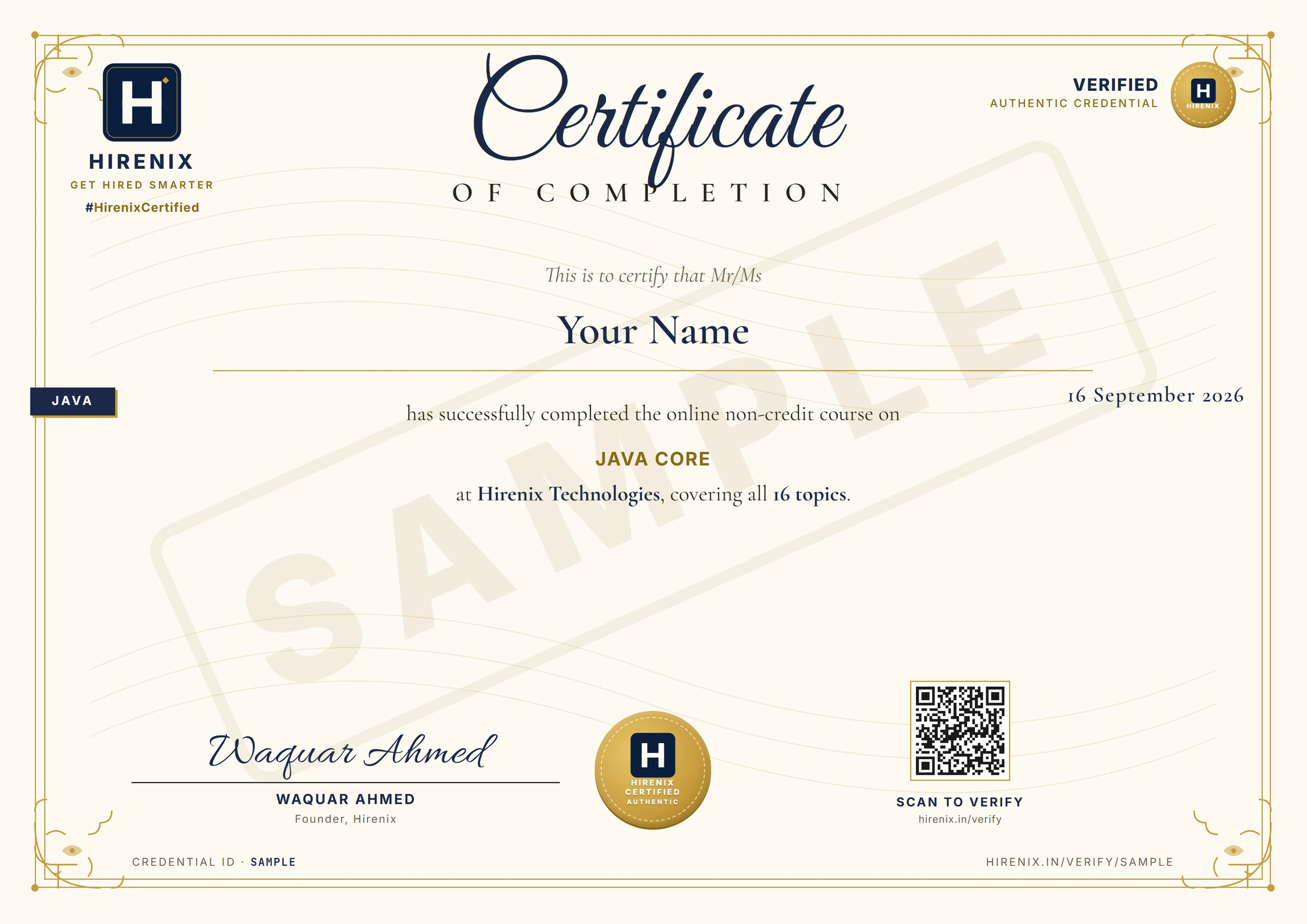
Verified credential
hirenix.in/verify/…
What you’ll learn
- ●HR round asal me kya judge karta hai
- ●STAR method aur aapka story bank
- ●Tell me about yourself: aapka pehla jawab
- Resume aur projects ka walkthroughPro
- Strengths aur weaknessesPro
- Pressure, deadlines aur prioritisingPro
- Teamwork aur leadershipPro
- Feedback, criticism aur motivationPro
- Yahi company kyun?Pro
- Hum aapko hire kyun karein?Pro
- Five-year goals aur commitmentPro
- Relocation, shifts aur flexibilityPro
- Failure, galtiyaan aur rejectionPro
- Conflict aur mushkil situationsPro
- Gaps, backlogs aur kam marksPro
- Aap current job kyun chhod rahe hain?Pro
- Trick aur opinion wale sawaalPro
- CTC vs in-hand salaryPro
- Expected salary aur negotiationPro
- Notice period, bond aur joining datePro
- HR se kya poochein, aur follow-upPro
- RecapPro
- Practice: Poora HR Round, Fresher aur Job SwitchPro
Free lessons
HR round asal me kya judge karta hai
Zyadatar candidates technical round ki taiyaari karte hain aur HR round ko formality maan lete hain. Is course ke peeche wale asli interview reports kuch aur kehte hain - aur ye bhi dikhate hain ki HR round aksar chhota hota hai, jisse har jawab ka wazan kam nahi, zyada ho jaata hai.
GeeksforGeeks par 16 asli interview reports (2021-2026) ye batate hain:
| Report me kya likha hai | Company / round |
|---|---|
| Poora HR round do sawaal ka tha: "Are you ready to relocate?" aur "Are you ready for night shift?" | TCS Ninja |
| HR ne relocation aur night shift poochha, phir document verification kiya | TCS Digital (2026 graduate) |
| Poora interview lagbhag saat minute chala: introduce yourself, project samjhaiye | Accenture ASE/AASE |
| Technical aur HR ek hi round tha; HR ne relocation aur night shift poochha | Cognizant GenC |
| Sawaalon ke baad HR ne college ID aur Aadhaar card dekha, aur poochha "Are you comfortable with the bond?" | Capgemini |
| 3-5 saal ke experienced hire ke liye HR round "just a CTC discussion" tha | Infosys |
| HR discussion ek chhoti phone call thi: current job kyun chhod rahe hain, aur CTC kitna mil raha hai | Paytm (2-3 saal) |
Matlab HR round ka koi ek fixed format nahi hai. Wo do haan/na wale sawaal ho sakta hai, technical + HR ka mila-jula round, document check, ya paise par phone call. Har format phir bhi ek filter hai.
HR asal me kya test kar raha hai
In sab formats me HR chhe cheezein chhaant raha hai. Inhe yaad rakhiye - is course ka har agla topic inme se kisi ek se juda hai.
- Communication. Kya aap simple English me saaf aur chhota jawab de sakte hain? Accent ka test nahi - "client aur manager aapki baat samjhenge ya nahi" ka test.
- Consistency aur imaandaari. Jo aap bol rahe hain, kya wo resume, technical round aur documents se match karta hai? Mismatch - dates, marks, project ka dawa - ek achhe interview ko bhi fail karne ka sabse tez tareeka hai.
- Stability. Kya aap tikenge? Fresher ko hire aur train karne me company ka time aur paisa lagta hai, isliye HR un signals ko sunta hai jo batate hain ki aap jaldi chhod denge: "I'm preparing for higher studies", "I just want some experience first", bina wajah ki job changes. Isiliye "Where do you see yourself in five years?" jaise sawaal hote hain.
- Flexibility. Kya aap job ko waisa hi lenge jaisi wo asal me hai - location, shifts, jis project par lagaya jaaye, service agreement agar ho? Upar TCS aur Cognizant ke reports dikhate hain ki ye tab bhi poochhe jaate hain jab aur kuch nahi poochha jaata.
- Attitude aur fit. Aap teammates, failures aur purane employers ke baare me kaise baat karte hain? Dosh dete hain, ya zimmedari lete hain?
- Logistics. Documents, joining date, notice period, salary expectation. Boring, par yahan ek galat jawab sab kuch clear karne ke baad bhi process khatam kar sakta hai.
Trap: "HR round to bas formality hai"
Trap ye maanna hai ki technical round mushkil tha, to HR round sirf shishtachaar hai. Candidates ise aise fail karte hain:
- "Aasaan" sawaalon par casual jawab. "Relocate? Hmm, I'd prefer my home city only." Aapke liye ye pasand hai; HR ke liye ye candidate hai jo posting mana kar sakta hai.
- Apni hi baat kaatna. Resume kehta hai aapne project lead kiya; HR round me aap kehte hain "my friend did most of it". HR notice karta hai, aur ab baaki sab par bhi shak karta hai.
- Chhodne ka plan bata dena. "I'll work for a year or two, then do an MBA." Imaandaar hai - aur theek wahi stability signal jise HR chhaant raha hai. (Higher studies wale sawaal ka imaandaar jawab topic 11 me hai.)
- Documents taiyaar nahi. Original marksheets ghar par, do certificates par naam ki alag spelling, resume ki dates offer letter se match nahi - aur koi explanation taiyaar nahi.
- Online round ki dikkatein. Band microphone, andhera kamra, camera ki jagah apna video dekhna, doosri window se padhna. Das minute ki call me teen minute setup me gaye to round ka ek-tihaai chala gaya.
- Ulta trap - zyada scripting. Chhote sawaalon ke lambe ratte hue jawab. HR ne haan ya na poochha; aapne bhaashan de diya.
Answer framework: Direct → Reason → Proof
Chhote round me zyadatar HR sawaal band ya lagbhag band hote hain: "Are you ready to relocate?", "Is this your original marksheet?", "When can you join?". Teen step ka dhaancha use kijiye:
- Pehle seedha jawab - haan, na, ya number/date - pehle kuch shabdon me.
- Ek wajah - kyun, ek vaakya me.
- Ek saboot ya shart - koi fact jo use support kare, ya ek imaandaar shart, shaanti se.
Wahin ruk jaaiye. HR ko aur chahiye hoga to wo poochhega. Ye dhaancha pehle teen filter ek saath paar karta hai: saaf hai (communication), check ho sakta hai (consistency), aur kuch chhupata nahi (imaandaari).
Har HR round se pehle ye checklist chalaiye:
| Round se pehle | Kyun |
|---|---|
| Apna resume line-by-line dobara padhiye | Us par likhi har cheez poochhi ja sakti hai; technical round ke jawab bhi usse match hone chahiye |
| Originals + ek photocopy set + phone me scans rakhiye: marksheets, degree/provisional certificate, ID proof; job switch karne walon ke liye offer/relieving letters aur haal ki payslips | Document verification usi round me ho sakta hai (TCS Digital, Capgemini reports) |
| Resume aur documents me har date aur naam ki spelling check kijiye | Document verification yahi mismatch dhoondhta hai |
| Relocation, shifts aur service agreement par apne imaandaar jawab call se pehle tay kar lijiye | Ye do-sawaal wale rounds me bhi poochhe jaate hain |
| Online: camera, microphone aur internet test kijiye; roshni ki taraf munh karke baithiye; camera aankh ki oonchaai par; baaki windows band | Setup fail hua to round kha jaata hai |
Online round - eye contact. Video par eye contact ka matlab hai camera me dekhna, screen par interviewer ke chehre ko nahi. Har waqt zaroori nahi; baat shuru aur khatam karte waqt camera me dekhiye. Background saada rakhiye aur backup ke liye phone hotspot taiyaar rakhiye.
Sample answer — fresher (template)
Situation: document verification ke waqt HR dekhta hai ki do documents par aapke naam ki spelling alag hai (ya koi date match nahi karti). Yahi jagah hai jahan Direct → Reason → Proof sabse zyada kaam aata hai - shaant, factual jawab mudda khatam kar deta hai; ghabraya hua ya gol-mol jawab shak paida karta hai. Interview me ise English me boliye:
"Yes, I'm aware of that. My [10th marksheet] shows my name as [spelling A], while my [degree certificate / Aadhaar] shows [spelling B], because [honest reason - e.g. the school board recorded it that way]. I have [proof - e.g. a gazette notification / an affidavit / a correction request submitted on [date]], and I can share a copy by [date]."
Abhi koi saboot nahi hai to wahi bataiye, aur ye bhi ki aap kya kar rahe hain: "I haven't got the correction yet; I have applied to [authority] and will send the document as soon as I receive it." Jo document aapke paas nahi hai, wo kabhi mat banaiye.
Sample answer — experienced (template)
Situation: HR bataata hai ki resume kehta hai aapne [Company] ek mahine me join kiya, par offer letter ya relieving letter doosra mahina dikhata hai.
"You're right - my resume says [Month Year], and my [offer / relieving] letter says [Month Year]. The difference is because [honest reason - e.g. I wrote the month I got the offer, but my joining date was [date]]. My [relieving letter / payslips from [first month]] show the exact joining date, and I'll correct the resume today so everything matches."
Company aapki employment dates purane employer se check kar sakti hai, isliye sirf wahi resume surakshit hai jiski dates aap saabit kar sakein. Gap chhupane ke liye "March" ko "Feb" likh dena theek wahi chhota mismatch hai jo bada shak ban jaata hai.
Follow-up grilling: HR aage kya poochhega
Ye follow-ups lagbhag kisi bhi chhote HR jawab ke baad aate hain. Har ek chhe filters me se kisi ek ko test karta hai. Sawaal English me hain kyunki HR aise hi poochhta hai.
| Follow-up | HR kya check kar raha hai | Kaise sambhaalein |
|---|---|---|
| "Are you sure? Think again." ("Yes, I can relocate" ke baad) | Aapka haan asli hai ya aadat se nikla | Shaanti se haan dohraiye, apni ek wajah ke saath. Koi asli shart hai to abhi bataiye - offer ke baad nahi. |
| "Why didn't you fix this mismatch earlier?" | Laaparwaahi ya imaandaari | Seedha maan lijiye ("I should have"), phir bataiye tab se kya kiya. Office ya university ke bahane nahi. |
| "Anything else in your documents or background we should know?" | Aap problem khud batate hain ya chhupate hain | Kuch hai (gap, backlog, pending result) to abhi bataiye, chhota, facts ke saath. Baad me mila surprise zyada bura hota hai. |
| "Your technical interviewer said you [X]. Is that right?" | Rounds ke beech consistency | Factually jawab dijiye. Pehle kuch galat bola tha to sudhaariye: "I was wrong there - the correct answer is..." |
| "Do you have any other plans - higher studies, government exams?" | Stability | Imaandaari se jawab dijiye (kaise, topic 11 me hai). Jo plan sach me hai use mana mat kijiye - wo aksar baad me saamne aa jaata hai. |
| "Your internet keeps dropping - should we reschedule?" | Pressure me problem kaise sambhaalte hain | Bataiye aap kya karenge ("I'm switching to my phone hotspot, one minute") ya reschedule izzat se maan lijiye. Baar-baar maafi mat maangiye. |
Kab use karein: band aur lagbhag band HR sawaalon ke liye - relocation, shifts, documents, dates, joining, "are you comfortable with..." - aur jab bhi HR koi mismatch pakde. Checklist har HR round se pehle chalaiye, recruiter ki phone call se pehle bhi.
Kab NAHI use karein: khule sawaalon ke liye jaise "Tell me about yourself" (topic 3) ya "Tell me about a time you failed" (topic 13) - wahan kahani chahiye, aur teen chhote vaakya taalne jaise lagenge. Aur "Direct" ka matlab rukha nahi hai: chhota jawab bhi garmjoshi bhara ho sakta hai - "Yes, happy to" direct hai; bina wajah ka "Yes." anicchha jaisa lag sakta hai.
Stability wo filter hai jise candidates sabse zyada bhoolte hain, kyunki wo kabhi seedha nahi poochha jaata. Plans, family, location aur higher studies wale sawaalon ke peeche use suniye - aur unka jawab sach ke saath dijiye, is baat par tika kar ki aapko yahi job abhi kyun chahiye.
STAR method aur aapka story bank
Kisi bhi HR round ka bada hissa aise sawaal hote hain jo "Tell me about a time...", "Give me an example of..." ya "Describe a situation where..." se shuru hote hain. Is course ke peeche wali lists aur reports me inme sabse aam hain failure aur galtiyan, pressure me kaam, teamwork, criticism aur conflict - aur GeeksforGeeks par Accenture ke interview write-ups team-lead wali situations bhi batate hain ("a member of your team can't finish their task - what do you do?").
Inhe behavioural questions kehte hain. Sab ek hi cheez maangte hain - ek asli kahani - isliye sabka jawab ek hi tool se diya ja sakta hai. Ye topic wo tool (STAR) sikhata hai, aur wo taiyaari jo use live interview me kaam karne layak banati hai: ek story bank.
HR asal me kya test kar raha hai
Behavioural sawaal ek soch par tika hai: kisi asli situation me aapne kaisa bartaav kiya, ye is baat ka behtar andaaza hai ki aap kaam par kaisa karenge - is se behtar ki aap kya kehte hain ki karenge. Isliye HR ye sun raha hai:
- Asli ghatna. Khaas log, khaas deadline, khaas problem. Gol-mol kahaniyan banayi hui lagti hain, chahe na hon.
- Aapke apne kaam. "Team" ya "we" ne kya kiya nahi - aapne kya tay kiya aur kiya.
- Judgment. Doosre raaston ke bajaye aapne wahi kaam kyun chuna.
- Nateeja. Aapke kaam se kya badla - chahe nateeja aadha hi achha raha ho.
- Reflection. Aapne kya seekha, ya ab kya alag karenge. Yahi ek mature jawab ko ek kismat wali kahani se alag karta hai.
Trap: kaun se jawab fail hote hain
- Hypothetical jawab. "Tell me about a time you handled pressure" poochha, candidate kehta hai "I would stay calm, prioritise and communicate." Ye kisi aur sawaal ka jawab hai. HR ne ek time maanga; aapne theory de di.
- "We" wali kahani. "We divided the work, we stayed late, we submitted on time." HR ko ab bhi nahi pata aapne kya kiya. Har "we" aapka hissa chhupa deta hai.
- Sirf situation, action nahi. Do minute project aur problem samjhane me, pandrah second ye batane me ki aapne kya kiya. Number action par milte hain.
- Nateeja nahi, ya ant nahi. Kahani "...so I talked to him." par ruk jaati hai. Phir?
- Hero kahani jo doosron ko dosh deti hai. "My teammates were lazy, so I did everything myself." Mehnat dikhti hai - aur team ko dosh dena bhi dikhta hai, jo HR attitude signal ki tarah note karta hai.
- Udhaar ki ya banayi hui kahani. Kisi prep website ki mashhoor kahani, ya dost ki internship apni bata kar. Doosre follow-up par toot jaati hai, kyunki details aapko pata nahi. Aur experience banana theek wahi cheez hai jise pakadne ke liye HR ka consistency check bana hai.
- Jam jaana. Interviewer ruka hua hai aur aap kahani dhoondh rahe hain. Ye taiyaari ki problem hai, ghabrahat ki nahi - aur neeche wala story bank ise theek karta hai.
Answer framework: STAR (Situation, Task, Action, Result)
STAR ka matlab hai Situation, Task, Action, Result:
| Step | Kya bolna hai | Kitna |
|---|---|---|
| Situation | Kahan aur kab; bas utna context jitna samajhne ke liye chahiye | 1-2 vaakya |
| Task | Aapki zimmedari kya thi, ya kya hona zaroori tha | 1 vaakya |
| Action | Aapne step-by-step kya kiya aur kyun - "I" me | Sabse bada hissa |
| Result | Uske kaaran kya hua; imaandaar number ho to wo; plus ek line ki kya seekha | 1-2 vaakya |
Santulan yaad rakhne ka aasaan tareeka: Situation aur Task chhote rakhiye, aur zyadatar samay Action par lagaiye. Bahut se candidates ulta karte hain.
Seekh jodna. Ek vaakya reflection ke saath khatam kijiye ("Since then, I..."). Failure aur mistake wale sawaalon me ye optional nahi - yahi jawab hai.
Story bank
Sawaal ke baad ke das second me achhi STAR kahani nahi banti. Isliye interview se pehle paanch-chhe bana lijiye, aur unhe dobara use kijiye. Ek achhi kahani aam taur par kai sawaalon me fit hoti hai:
| Sawaal ka parivaar | Kaunsi kahani chahiye |
|---|---|
| Pressure / tight deadline | Jab asli time crunch ke bawajood aapne kaam pura kiya |
| Teamwork / team lead | Jab aapne doosron ke saath kaam kiya, behtar ho ki team me kuch gadbad hui ho |
| Conflict / asehmati | Jab aap kisi se asehmat the aur bina dosh diye suljhaya |
| Failure / mistake | Ek asli failure ya galti - jo aapki ho, aur uske baad aapne kya badla |
| Criticism / feedback | Jab kadvi feedback mili aur aapne us par kaam kiya |
| Achievement / initiative | Kuch jis par aapko garv hai aur jo aapne khud shuru kiya ya aage badhaya |
Kaise banayein:
- Har wo jagah list kijiye jahan aapka asli experience hai: projects, internship, part-time kaam, college events, sports, ghar ki zimmedariyan, clubs.
- Table ki har row ke liye ek asli ghatna chuniye. Ek ghatna do rows cover kar sakti hai (project ka sankat "pressure" bhi ho sakta hai aur "teamwork" bhi).
- Har kahani STAR me bullet points me likhiye - ratne ke liye paragraph nahi. Dimaag me facts chahiye, vaakya nahi.
- Har kahani zor se boliye, lagbhag ek se do minute me.
- Har kahani ke liye neeche wali table ke teen follow-ups taiyaar kijiye.
Freshers aksar sochte hain ki unke paas kahaniyan nahi hain. College bahut deta hai: project partner jo beech me chala gaya, fest jahan sponsor peeche hat gaya, exam week jo submission se takra gaya, hostel ya club ki zimmedari. Ghatna kitni badi hai isse zyada zaroori hai ki aap apni soch kitni saaf dikhate hain.
Sample answer — fresher (template)
Sawaal: "Tell me about a time you worked under pressure." Interview me ise English me boliye:
"In my [final year / third semester], our team of [number] had [one sentence situation - e.g. two weeks to submit our [project name] project], and [what went wrong - e.g. one member had to leave for a family emergency]. My task was [your responsibility - e.g. the backend, and now also his part - the report generation module]. I [action 1 - e.g. listed what was left and split it into daily targets], [action 2 - e.g. asked our guide which features were essential so we could drop the rest], and [action 3 - e.g. took the report module myself and stayed in touch with him so he could review it when he was back]. We [honest result - e.g. submitted on time with the core features working and scored [grade]]. What I learned is [reflection - e.g. to cut scope early instead of hoping to finish everything], and I've done that in every project since."
Har [bracket] aapki asli kahani hai. Agar nateeja aadha hi achha tha ("we submitted, but one feature didn't work"), to wahi boliye - asli, adhoora nateeja ek perfect nateeje se zyada vishwasniya lagta hai.
Sample answer — experienced (template)
Sawaal: "Tell me about a time you had a conflict with a colleague."
"At [company type], I was working on [project/feature] with a [role - e.g. colleague from the testing team]. We disagreed about [issue - e.g. whether to release on [date] with [number] known minor bugs]. My task was [responsibility - e.g. to get the release ready without damaging the working relationship]. I [action 1 - e.g. asked for a short call instead of arguing on the ticket], [action 2 - e.g. went through each bug with her and agreed which were really blocking], and [action 3 - e.g. proposed releasing on [date] with a fix for the two blocking ones and a follow-up patch plan]. The result was [honest result - e.g. we released [number] days later than planned but without the issues she was worried about]. What I took from it is [reflection - e.g. to raise disagreements on a call early rather than in comments]."
Dhyaan dijiye kya nahi hai: koi dosh nahi, "she was wrong" nahi, "I was right" nahi. HR sun raha hai ki aap logon ke saath kaise kaam karte hain, ye nahi ki kaun jeeta.
Follow-up grilling: HR aage kya poochhega
Har STAR kahani ye follow-ups bulaati hai. Apne bank ki har kahani ke liye inhe taiyaar kijiye. Sawaal English me hain kyunki HR aise hi poochhta hai.
| Follow-up | HR kya check kar raha hai | Kaise sambhaalein |
|---|---|---|
| "What exactly did you do?" | Aapka hissa vs team ka | Do-teen kaam bataiye jo aapke the, "I" me. |
| "What would you do differently now?" | Reflection aur maturity | Ek asli badlaav bataiye. "Nothing" ya to jhootha lagta hai ya bina soch ka. |
| "What did the other person say / how did they react?" | Kahani asli hai ya nahi, aur kya aapne doosri taraf ko samjha | Unka nazariya do-ek vaakya me imaandaari se bataiye. Asli kahaniyon me ye detail hoti hai. |
| "Give me another example." | Kya aapke paas ek se zyada taiyaar kahani hai | Bank ki agli kahani use kijiye - isiliye paanch-chhe banayi jaati hain. |
| "What if that hadn't worked?" | Kya aap options me sochte hain | Agla kadam imaandaari se bataiye - kisse poochhte, kya kaat dete. |
| "How did you measure that result?" | Number asli hai ya nahi | Sirf wahi number boliye jo aap samjha sakein. Nahi hai to nateeja shabdon me bataiye. |
| "Tell me about a time it did not go well." | Kya aapke paas sirf success wali kahaniyan hain | Apni failure wali kahani use kijiye. Zimmedari lijiye, phir seekh. |
Kab use karein: jab bhi sawaal kisi ghatna ko maange - "Tell me about a time...", "Give me an example...", "Describe a situation...", "Have you ever...?" - aur "How do you handle X?" wale sawaalon me bhi, jahan chhota STAR example aapki aadaton ke varnan se zyada mazboot hota hai.
Kab NAHI use karein: band aur logistics wale sawaalon ke liye (relocation, shifts, salary, notice period - topic 1 ka Direct → Reason → Proof use kijiye); "Tell me about yourself" ke liye (Present → Past → Future, topic 3); aur jab HR sirf hypothetical poochhe - "What would you do if...?" Wahan pehle do-teen vaakya me apna tareeka bataiye, aur phir, agar ho to, "Something similar happened when..." se chhota example jodiye. Jis sawaal ne do minute ki STAR kahani maangi hi nahi, us par zabardasti mat thopiye.
Tell me about yourself: aapka pehla jawab
"Tell me about yourself" lagbhag har Indian HR round ka pehla sawaal hota hai. Is course ke liye humne 14 prep-site question lists aur GeeksforGeeks par 16 asli interview reports (TCS, Infosys, Wipro, Accenture, Cognizant, Capgemini, HCL, Paytm, 2021-2026) gine. Ye sawaal 14 me se 13 lists me aur 16 me se 5 reports me mila. Kul ginti me sirf ek sawaal iske barabar pahuncha: "Are you willing to relocate?"
Sunne me ye halki-phulki baat lagti hai. Hai nahi. Asli HR rounds chhote hote hain - ek TCS Ninja report me poora HR round sirf do sawaal ka tha - isliye aksar yahi jawab aapka aadha round hota hai. Aur ye akela sawaal hai jahan agla sawaal kya hoga, ye aap tay karte hain. Aap jo bhi zikr karenge, wahi follow-up ban sakta hai.
HR asal me kya test kar raha hai
HR aapki biography nahi likh raha. Aapka resume pehle se table par hai. Lagbhag ek minute me wo paanch cheezein dekh raha hai:
- Structure. Kya aap 60-90 second tak ek saaf order me bol sakte hain, resume padhe bina? Ye iska andaaza hai ki aap client ya manager ko cheezein kaise samjhayenge.
- Judgment. Aapne jo kuch kiya hai, usme se is job ke liye kya zaroori hai - kya aap chun sakte hain? Chunna hi skill hai. List bana dena skill nahi hai.
- Consistency. Jo aap bol rahe hain, kya wo resume se match karta hai? Ye imaandaari ka test hai. Jis project ko aap gol-mol samjhayein, ya jo skill aap saabit na kar paayein, wo turant pakda jaata hai.
- Direction. Kya aapki kahani isi role par aakar khatam hoti hai, ya ye kisi bhi interview me chipkayi ja sakti hai?
- Composure. Ye pehla sawaal hai. Yahan shaant aur steady rehna poore round ka mood set karta hai - dono taraf ke liye.
Saaf, simple English zaroori hai; accent nahi. HR ye dekh raha hai ki aapki baat samajh aati hai ya nahi, ye nahi ki aap "polished" lagte hain ya nahi.
Trap: kaun se jawab fail hote hain
Trap ye hai ki sawaal khula hai. Khula sawaal aapko lalchaata hai ki jo ratta maara hai wahi bhar dein. Ye jawab fail hote hain, aur kyun:
- Resume padh dena. "My name is X. I did my 10th from ABC School with 85%, my 12th from..." HR padh sakta hai. Round ka akela khula minute aapne ek document dohraane me laga diya, aur dikha diya ki aap priority tay nahi kar paate.
- Family se shuruaat. "My father is a government employee, my mother is a homemaker, I have one younger sister..." Aapke parivaar me kuch galat nahi - par shuruaat ke taur par ye HR ko job ke baare me kuch nahi batata. Chahiye hoga to wo khud poochhenge (neeche follow-ups dekhiye).
- Adjectives ki list. "I am hard-working, dedicated, a quick learner and a team player." Ye har candidate bolta hai. Bina saboot ke har adjective ek challenge ban jaata hai: "Quick learner? Give me an example."
- Ratta hua script, tez raftaar me. Rehearsed lagta hai, aur HR ke beech me tokte hi bikhar jaata hai - aur HR aksar jaan-boojh kar tokta hai.
- Galat length. Ek line ("I'm X, a B.Tech student, that's it") lagti hai ki taiyaari nahi ki. Teen se paanch minute lagta hai ki aap maahaul nahi padh paate.
- Bluff wala hook. "I am an expert in machine learning." Ab agla sawaal machine learning par hi aayega. Aisi koi skill, tool ya project ka naam kabhi mat lijiye jis par aap do minute na bol sakein.
- Paisa ya shikayat (experienced). "I'm looking for a better package" ya "my current company has no growth". Dono se "aap kyun chhod rahe hain" par grilling shuru hoti hai, aur pehla wala HR ko ye bhi batata hai ki better package milte hi aap unhe bhi chhod denge.
Answer framework: Present → Past → Future
Teen hisse, isi order me. Zyadatar prep guides poore jawab ko ek se do minute rakhne ko kehte hain; lagbhag 60-90 second ka target rakhiye taaki follow-ups ke liye jagah bache.
| Hissa | Fresher | Experienced (job switch) |
|---|---|---|
| Present - aap abhi kaun hain (1-2 line) | Degree, branch, college, final year ya haal hi me graduate; kis area me sabse zyada interest hai | Abhi ka role, company kis type ki hai, kitne saal ka experience, domain |
| Past - 2-3 saboot | Ek project jisme aapka hissa aur ek imaandaar nateeja; internship, certification ya koi zimmedari | Do kaam jinhe aap gehraai se samjha sakein, unke asar ke saath |
| Future - ye role kyun | Ye job wo kya deti hai jo aapke saboot wali direction se match karta hai | Aage kahan grow karna chahte hain, aur ye role usme kaise fit hota hai |
Hook ka niyam. Har noun soch-samajh kar chuniye. Aap jo bhi zikr karenge, HR us par poochh sakta hai - isliye wahi cheezein bolein jin par aap chahte hain ki sawaal aaye. Achha introduction do-teen aise follow-ups plant karta hai jinki taiyaari aap pehle se kar chuke hain.
Imaandaari ka niyam. Jawab ka har fact aapka hona chahiye. Internship nahi hai to wo line hata dijiye; banaiye mat. Ek line kam hone se kuch nahi bigadta. Ek banayi hui line jo ek follow-up me toot jaaye, offer le doob sakti hai.
Sample answer — fresher (template)
Ye template hai, script nahi. Har [bracket] aapki zindagi ka ek fact hai. Interview me ise English me, apne shabdon me boliye.
"I'm [Name], a final-year [B.Tech in Computer Science / BCA / B.Com] student at [College], [City]. Over the last two years I've been most interested in [area - e.g. backend development / data analysis], and the best proof of that is my [final-year / personal] project, [Project name] - [one line on what it does]. My part was [your exact contribution - e.g. the database design and the login API], and [one honest result - e.g. our department now uses it to collect event registrations]. I also [one more proof point - e.g. did a two-month internship at a [type of company] where I [task] / completed [certification]]. Outside academics, I [one true activity - e.g. coordinate our college coding club]. I'm looking for a role where I can [what this job offers], which is why this [role] at [Company] interests me."
Batane layak project ya internship nahi hai? Jo aapne kiya hai wahi use kijiye: koi subject jisme aap gehraai tak gaye aur usse kya banaya ya suljhaya, koi zimmedari (class representative, fest team, ghar ka business), ya self-learning jiska kuch dikhane layak nateeja ho. Achievement kitni badi hai, isse zyada zaroori hai ki saboot hai.
Sample answer — experienced (template)
"I'm [Name]. I've been working as a [role] for [N] years, currently at [type of company - e.g. an IT services company / a fintech startup], on [domain or product]. In my current role I [main responsibility], and the piece of work I'm proudest of is [specific impact you can explain in detail - e.g. automating a monthly report that took the team two days, so it now runs in under an hour]. Before this, I [previous role in one line, with the reason you moved forward]. Over these years I've realised I want to [direction - e.g. work closer to the product / on larger systems / lead a small team], and that's why this [role] at [Company] fits - [one specific reason tied to the job description]."
"Main kyun chhod raha hoon" ko introduction se bahar rakhiye, jab tak wo Future line me apne aap fit na ho. Wo alag sawaal ban kar aayega - uski taiyaari alag se kijiye (topic: why are you leaving).
Follow-up grilling: HR aage kya poochhega
Aapka introduction agle paanch minute tay karta hai. Ye wo follow-ups hain jo is course ke sources me mile, har ek kya check karta hai, aur use kaise sambhaalein. Sawaal English me hain kyunki HR aise hi poochhta hai.
| Follow-up | HR kya check kar raha hai | Kaise sambhaalein |
|---|---|---|
| "You mentioned [project]. What exactly did you do in it?" | Ownership, ya team ka credit apne naam | "I" me boliye, apna khaas hissa bataiye, aur ek problem jo aapne khud suljhayi. |
| "Tell me something that's not on your resume." | Kaagaz se aage ki gehraai, aur taiyaari ki ya nahi | Ek doosri sachchi kahani taiyaar rakhiye: koi zimmedari, koi turnaround, ya koi hobby jisme aap gehre hain. |
| "What are your hobbies?" - phir "What was the last one you did?" | Hobby asli hai ya resume bharne ke liye | Sirf wahi hobby bataiye jo aap sach me karte hain. Ek Wipro candidate se poochha gaya ki hobby ko hi career kyun nahi banaya - taiyaar rahiye ki aapne yahi career kyun chuna. |
| "Tell me about your family." | Background aur stability | Do-teen izzat bhari lines, phir baat wapas apne par laaiye. Jo aap share nahi karna chahte, wo batana zaroori nahi. |
| "Why [your branch]? Why IT after [a non-CS branch]?" | Aapki career kahani consistent hai ya nahi | Asli wajah bataiye, aur dikhaiye ki uske liye aapne kya kiya (courses, projects) - wajah plus action. |
| "Okay - say that again in 30 seconds." ya jawab ke beech me tokna | Structure hai ya ratta hua script | Present → ek saboot → Future tak chhota kijiye. Structure pata ho to aap use chhota kar sakte hain. |
| "You said you're a quick learner. Prove it." | Adjectives ke peeche saboot hai ya nahi | Ek chhota example dijiye: kya seekha, kitni jaldi, usse kya banaya. Aur agli baar adjective ki jagah seedha example boliye. |
| (Experienced) "So why are you looking for a change?" | Stability, aur Future line imaandaar thi ya nahi | Jawab me bataiye aap kis taraf ja rahe hain, kis cheez se bhaag rahe hain wo nahi. Apni abhi ki company ki burai kabhi mat kijiye. |
Kab use karein: "Tell me about yourself", "Introduce yourself" aur "Tell me about your background" ke liye - HR round me, technical round ki shuruaat me, video introduction me, aur recruiter ki pehli phone call par.
Kab NAHI use karein: jab HR saaf kahe "Walk me through your resume" - tab resume ke order me chaliye (agla topic). Jab ek line ka introduction maanga jaaye (group discussion, panel me roll-call), tab sirf Present wala hissa. Aur jo interviewer pehle hi sun chuka hai, use wahi 90 second shabd-ba-shabd mat dohraiye - chhota kijiye aur wo hissa pehle rakhiye jo unke round ke liye zaroori hai.
Practice kaise karein: phone par khud ko record kijiye aur time dekhiye. Phir har noun ki list banaiye jo aapne bola, aur har ek ke liye poochhiye, "Kya main is par do minute bol sakta/sakti hoon?" Jahan jawab "nahi" hai, wo cheez jawab se nikal dijiye.